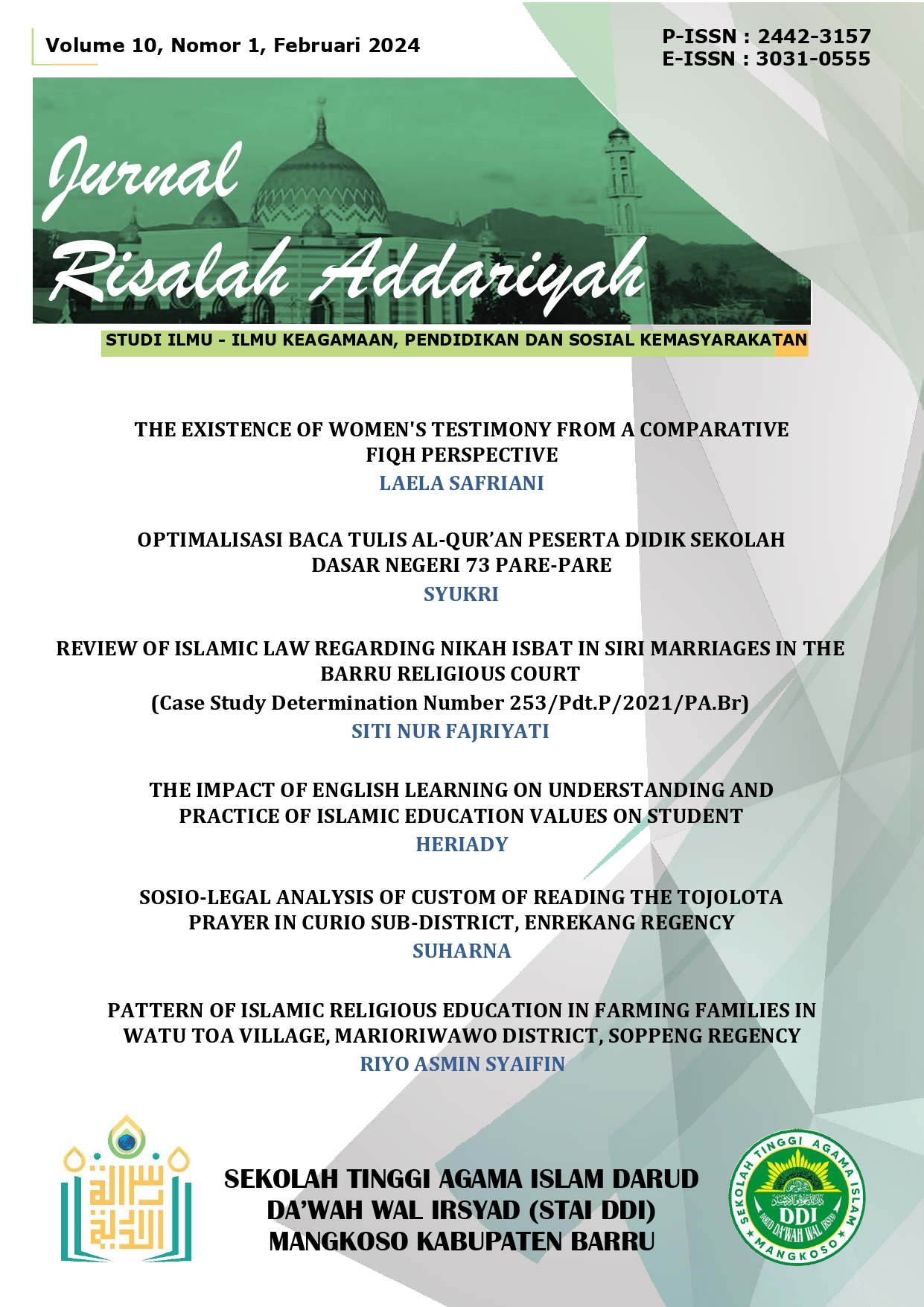
THE EXISTENCE OF WOMEN'S TESTIMONY FROM A COMPARATIVE FIQH PERSPECTIVE
DOI:
https://doi.org/10.56324/jariyah.v10i1.69Keywords:
Testimony, Woman, Comparative FiqhAbstract
This research aims to determine the existence of women's testimony from a comparative jurisprudence perspective. The type of research used in this research is library research, data is collected by quoting and analyzing using content analysis on literature or books that are relevant to the problem being discussed as well as the opinions of jurists (Islamic legal experts) then reviewing and concluding.The research results show that from several opinions and arguments regarding women's testimony, it can be concluded that in general women should not be witnesses in hudud matters, such as cases of adultery. The evidence of the Koran supports this opinion and is widely narrated by the Prophet's friends. Meanwhile, in matters relating to rights and property, such as divorce, reconciliation, gifts, wills, etc., women's testimony is permitted, whether together with men or consisting of several women, based on several historical reports. This can be taken into consideration considering that women in this century have received education like men, they generally also work outside the home. Likewise, the flow of information is very fast in the midst of society, reaching far to remote villages. Research also shows that women's memory and intellectual abilities are potentially no different from men.
References
Kementerian Agama RI. Al-Qur’an dan Terjemahnya, Edisi Revisi. Semarang: Toha Putera, 1989
Audah, Abdul Qadir. al-Tasyri’ al-Jana’iy al-Islamiy: Muqaranan bi al-Qanun al-Wadhiy, Juz 2. Cet. XIV; Beirut: Muassasah al-Risalah, 1998.
al-Bukhari, Abu Abdillah Muhammad bin Ismail. Shahih Bukhari, Juz 3. Cet. I; Beirut: Dar al-Kutub al-Ilmiyyah, 1992.
Dahlan, Abdul Azis…[et al.]. Ensiklopedi Hukum Islam, Jilid 3. Cet. I; Jakarta: Ichtiar Baru Van Hoeven, 1996.
al-Halwi, Abd. Fath Muhammad al-Halwi dan Abdullah bin Abdul Muhin al-Turkiy, al-Fikr-Mughni li Ibni Qudamah, Juz 9. Cet. II; Kairo: Hajr, 1992.
Ibnu Hazm, Abu Muhammad Ali ibn Ahmad. al-Muhall, Juz 9. Beirut: Dar al-q al-Jaddah, t.th.
Al-Jurjawi, Ali Ahmad. Hikmah al-Tasyri’wa Falsafatuhu, Juz 2, h. 68, dalam Abdus Salam, “Batas Minimal Saksi Menurut Fiqh Islam: Nisab Syahadah”, “Mimbar Hukum”
Mertokusumo, Sudikno. Hukum Acara Perdata Indonesia. Yogyakarta: Liberty, 1985.
Qal’ahji, Muhammad Rawwas. Maushu’ah Fiqh Umar Ibnil Khattab ra, diterjemahkan oleh M. Abdul Mujieb As. dkk, dengan judul Ensiklopedi Fiqih Umar bin Khattab. Cet. I; Jakarta: RajaGrafindo Persada, 1991.
Sabiq, Sayyid. Fiqh al-Sunnah, Jilid 3. Beirut: Dar al-Kitab al-Arabiy, t.th.
Ash-Shabuni, Muhammad Ali. Tafsir Ayat al-Ahkam min al-Qur'an, Jilid 2. Cet. I; Beirut: Dar al-Kutub al-Ilmiyyah, 1999.
Shihab, M. Quraish Shihab. Tafsir al-Misbah: Pesan, Kesan, dan Keserasian al-Qur'an, Volume 1, 2, dan 14. Cet. XI; Jakarta: Lentera Hati, 2008.
Taufiq, “Nilai Kesaksian Wanita Menurut Syariat Islam”, dalam Mimbar Hukum: Aktualisasi Hukum Islam”, No. 34 Tahun VIII 1997, h. 10.
Downloads
Published
How to Cite
Issue
Section
License
Copyright (c) 2024 Laela Safriani

This work is licensed under a Creative Commons Attribution-NonCommercial-ShareAlike 4.0 International License.
Copyright and Licensing
-
Copyright and Licensing
-
Usage Rights
All articles in this journal are licensed under the Creative Commons Attribution-NonCommercial-ShareAlike 4.0 International License (CC BY-NC-SA 4.0).
This license allows anyone to copy, distribute, display, and adapt the material in any medium or format, as long as the terms of the license are followed. -
License Terms
-
Attribution: Proper credit must be given to the original author, a link to the license must be provided, and any changes made must be indicated.
-
NonCommercial: The material may not be used for commercial purposes.
-
ShareAlike: If the material is remixed, transformed, or built upon, the resulting work must be distributed under the same license — CC BY-NC-SA 4.0.
-
No Additional Restrictions: You may not apply legal terms or technological measures that legally restrict others from doing anything the license permits.
-
-
Notices
-
The license does not apply to material in the public domain or uses permitted by legal exceptions or limitations.
-
No warranties are given by the licensor. Users are responsible for ensuring compliance with other rights, such as copyright, privacy, or moral rights.
-
-