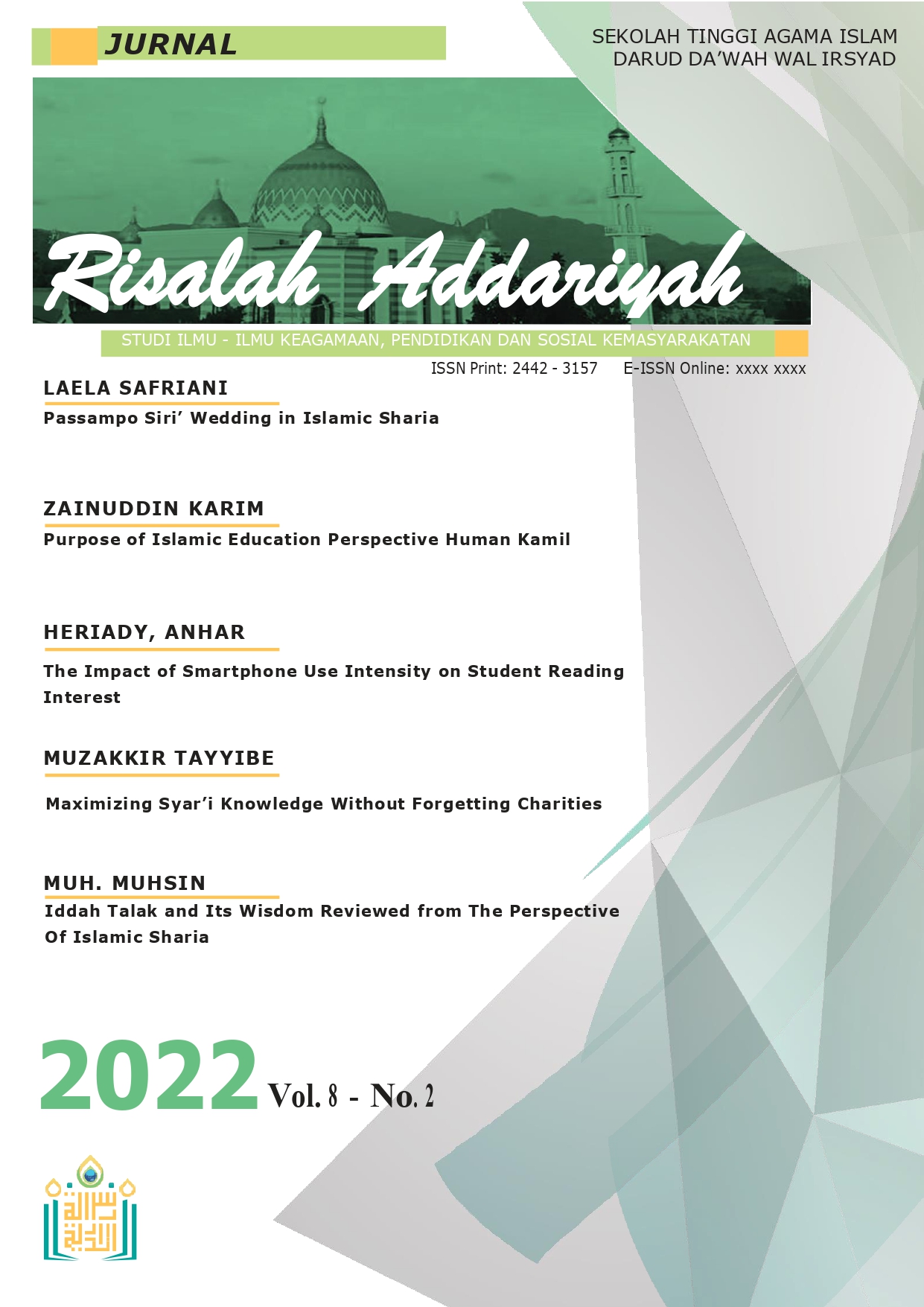
TUJUAN PENDIDIKAN ISLAM PERSPEKTIF INSAN KAMIL
PURPOSE OF ISLAMIC EDUCATION PERSPECTIVE HUMAN KAMIL
DOI:
https://doi.org/10.56324/jariyah.v8i2.43Keywords:
Kata Kunci: Insan Kamil, Pendidikan Islam, Tujuan Pendidikan IslamAbstract
The aim of this article is to discuss how the meaning of man is perfect in view of the purpose of Islamic education. This research is a type of literature research. Library research is a method used by reviewing books related to the theme discussed. In collecting data, the author uses a literature study, which is research conducted by using data related to the purpose of Islamic education from books, journals, newspapers, the internet and other relevant sources. The results of this study suggest the purpose of Islamic education oriented towards human beings. That is, it explains man's position as a servant of God, the purpose of man's creation, and how man obtains prosperity and happiness in this world and in the Hereafter. Humans cannot become human beings without going through the process of education, through education humans can be educated both intellectually intelligent, spiritually intelligent, and intelligently behaved.
References
Achmadi, Abu, Islam sebagai Paradigma Ilmu Pendidikan Yogyakarta: Aditya, 1992.
Arief, Arifuddin, Tanya Jawab Masalah Pendidikan dan Pembelajaran Cet. I; Palu: Endece Press, 2011.
Azra, Azyumardi, Pendidikan Islam Tradisi dan Modernisasi di Tengah Tantangan Milenium III Cet; Jakarta: Kencana Prenada Media Group, 2012.
Langeveld, (terj) Paedagogik Teoritis/Sistematis Jakarta: FIF-IKIP, 1971.
Langgulung, Hasan, Pendidikan Islam Menghadapi Abad ke-21 Cet I.; Jakarta: 1988.
Nata, Abuddin, Ilmu Pendidikan Islam Cet. III; Jakarta: Kencana, 2016.
Mahmud, H, Pemikiran Pendidikan Islam Cet. I; Bandung: Pusaka Setia, 2011.
Hasan Langgulung, Asas-asas Pendidikan Islam (Jakarta: Pustaka al-Husana, 2003.
Fatah Syukur, Paradigma Baru Filsafat Pendidikan Islam Cet. I: Depok; Kencana, 2017.
Fitriana, Hakikat Dasar Pendidikan Islam. Tarbawy?: Jurnal Pendidikan Islam, 7 (2).
Marimba, D Ahmad, Pengantar Filsafat Pendidikan Islam Bandung: al-Ma’arif, 1987.
Ramayulis, Ilmu Pendidikan Islam (Cet. XII; Jakarta: Kalam Mulia, 2015.
Downloads
Published
How to Cite
Issue
Section
License
Copyright and Licensing
-
Copyright and Licensing
-
Usage Rights
All articles in this journal are licensed under the Creative Commons Attribution-NonCommercial-ShareAlike 4.0 International License (CC BY-NC-SA 4.0).
This license allows anyone to copy, distribute, display, and adapt the material in any medium or format, as long as the terms of the license are followed. -
License Terms
-
Attribution: Proper credit must be given to the original author, a link to the license must be provided, and any changes made must be indicated.
-
NonCommercial: The material may not be used for commercial purposes.
-
ShareAlike: If the material is remixed, transformed, or built upon, the resulting work must be distributed under the same license — CC BY-NC-SA 4.0.
-
No Additional Restrictions: You may not apply legal terms or technological measures that legally restrict others from doing anything the license permits.
-
-
Notices
-
The license does not apply to material in the public domain or uses permitted by legal exceptions or limitations.
-
No warranties are given by the licensor. Users are responsible for ensuring compliance with other rights, such as copyright, privacy, or moral rights.
-
-