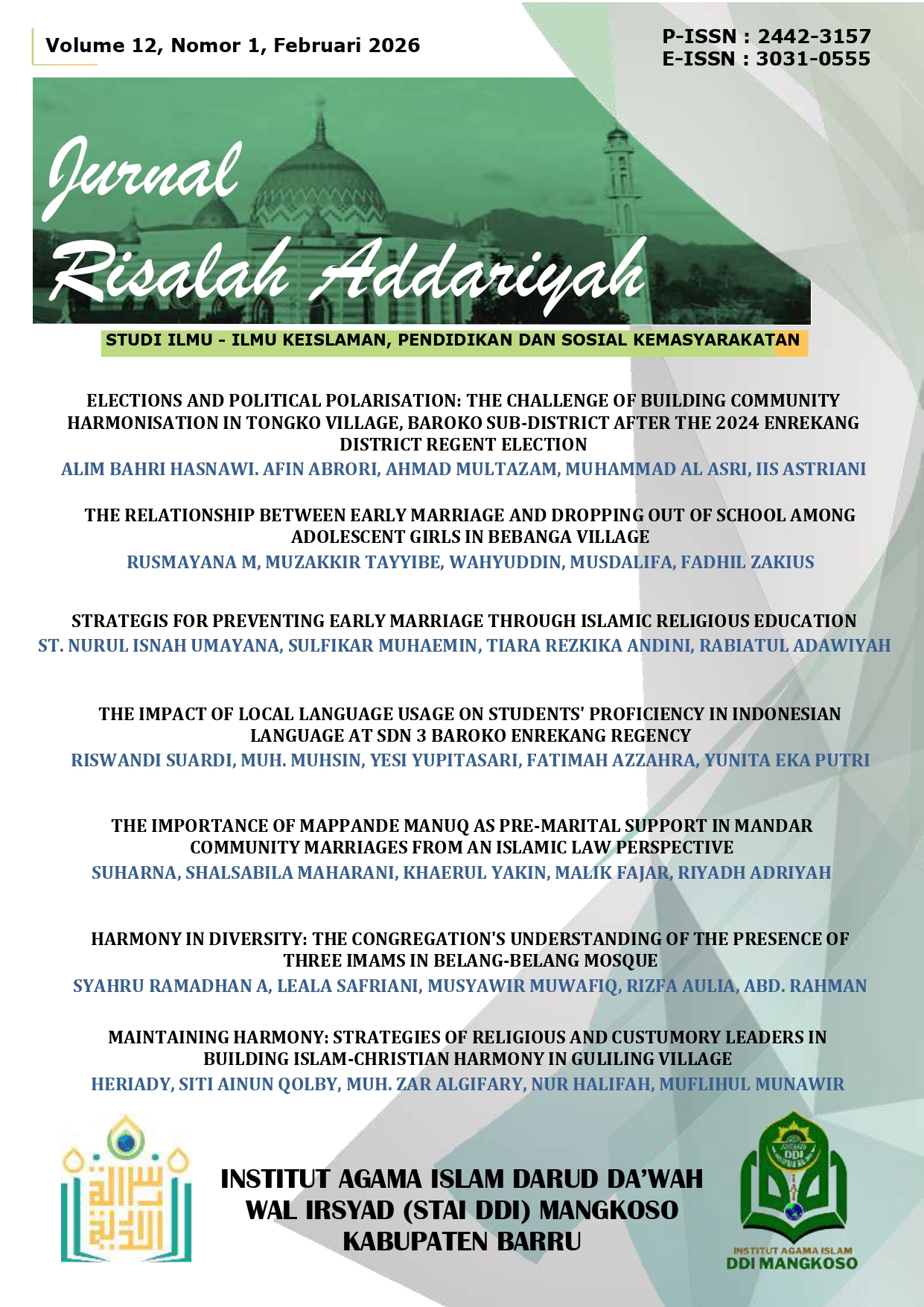
THE RELATIONSHIP BETWEEN EARLY MARRIAGE AND DROPPING OUT OF SCHOOL AMONG ADOLESCENT GIRLS IN BEBANGA VILLAGE
DOI:
https://doi.org/10.56324/jariyah.v12i1.156Keywords:
relationships, early, marriage, dropping, out, teenage, girlsAbstract
Marriage is a bond of body and soul aimed at forming a sakinah, mawaddah, and rahmah family, but social reality shows a high rate of early marriages that deviate from the ideal age limits according to Law No. 16 of 2019 and psychological perspectives. This study aims to explore the causes and impacts of early marriage, particularly those occurring in Bebanga Village, Kalukku District. The research method used is descriptive qualitative with data collection techniques through observation and interviews with community leaders and educators. The results of the study indicate that early marriage is triggered by various complex factors, including economic limitations, low education levels, local customary traditions, as well as married by accident (MBA) factors due to unsupervised free association by parents. Field findings indicate that the normalization of interactions between the opposite sexes and the lack of parental understanding of long-term impacts are the main causes of the increase in marriage rates each year. Early marriage has significant impacts on women's reproductive health risks, an increase in school dropouts, and mental unpreparedness in taking on household responsibilities. As a solution, this study emphasizes the importance of intensive education for parents regarding child-rearing according to religious law and strengthening oversight of adolescent interactions to minimize future legal and social consequences. Through this research, it is hoped that society can be wiser in understanding the essence of marriage as a long-term act of worship that requires both physical and psychological maturity.
References
Almahisa, Y. S., & Agustian, A. (2019). Pernikahan Dini Dalam Perspektif Undang-Undang Perkawinan Dan Kompilasi Hukum Islam.
Ilmu-ilmu, J. (2023). Jurnal El-Qanuniy --------------------------------------------------. 263–276.
Kecamatan, D. I., & Kabupaten, K. (2018). Jurnal Ibu dan Anak . Volume 6, Nomor 2, November 2018 96. 6(November), 96–103.
Kudus, M. S. (n.d.). Analisis faktor penyebab pernikahan dini dan dampaknya bagi pelakunya.
Kurniawan, H., Nurngaini, T., Mubarok, Z., & Afrina, A. (2022). Konsep Keluarga Sakinah Menurut Hamka. Jurnal Kajian Pendidikan Islam. https://doi.org/10.58561/jkpi.v1i2.33
Masyarakat, P. K., Sekarayu, S. Y., Nurwati, N., Sosial, I. K., & Reproduksi, K. (2021). Dampak pernikahan usia dini terhadap kesehatan reproduksi 1.
Mutiah, N. R. (2024). Analisis Penyebab dan Dampak Pernikahan Dini ( Studi Kasus di Desa Rejosari , Kecamatan Bojong ). 7(1).
Ndala, A. T., Teku, W. C., & Malik, Y. F. (2024). Menikah Muda?: Menggali Dampak Tersembunyi pada Pendidikan dan Karir Married Young?: Exploring the Hidden Impact on Education and Career. 2(6).
No Title. (2001). 22.
Padlah, N. N. (2022). Faktor Ekonomi Terhadap Pernikahan Dini. 16(2), 99–104. https://doi.org/10.20414/qawwam.v16i2.5205
Perempuan, D., Desa, D. I., Cianjur, X. K., Mayasari, D., & Siswanto, H. (2015). Prosiding Seminar Nasional Kebidanan ___________________________STIKes Respati Tasikmalaya. 66–71.
Rakhmat, D., Yang, T., Esa, M., & Indonesia, P. R. (1974). UU No. 1 Tahun 1974 Tentang Perkawinan. 1–15.
Sari, L., & Karliani, E. (2023). Pernikahan Dini dan Implikasinya Pada Angka Putus Sekolah di Desa Tumbang Habaon Kecamatan Tewah Kabupaten Gunung Mas. 2023(15), 428–433.
Syakhshiyyah, A., Islam, U., & Datokarama, N. (2024). Hakikat Tujuan Pernikahan dalam Pandangan Hukum Islam. 0, 194–197.
Syam, H., Ariga, W., Ayusna, R. P., Atika, N. F., Islam, U., Sjech, N., Djambek, M. D., & Barat, S. (2025). Hakekat Pernikahan dalam Konseling Keluarga Hakekat Pernikahan dalam Konseling Keluarga.
Downloads
Published
How to Cite
Issue
Section
License
Copyright (c) 2026 Rusmayana Rusmayana, H.Muzakkir Tayyibe, Wahyuddin Misbahuddin, Musdalifah Musdalifah, Muh. Fadhil Zakius Silmi Al-haq

This work is licensed under a Creative Commons Attribution-NonCommercial-ShareAlike 4.0 International License.
Copyright and Licensing
-
Copyright and Licensing
-
Usage Rights
All articles in this journal are licensed under the Creative Commons Attribution-NonCommercial-ShareAlike 4.0 International License (CC BY-NC-SA 4.0).
This license allows anyone to copy, distribute, display, and adapt the material in any medium or format, as long as the terms of the license are followed. -
License Terms
-
Attribution: Proper credit must be given to the original author, a link to the license must be provided, and any changes made must be indicated.
-
NonCommercial: The material may not be used for commercial purposes.
-
ShareAlike: If the material is remixed, transformed, or built upon, the resulting work must be distributed under the same license — CC BY-NC-SA 4.0.
-
No Additional Restrictions: You may not apply legal terms or technological measures that legally restrict others from doing anything the license permits.
-
-
Notices
-
The license does not apply to material in the public domain or uses permitted by legal exceptions or limitations.
-
No warranties are given by the licensor. Users are responsible for ensuring compliance with other rights, such as copyright, privacy, or moral rights.
-
-