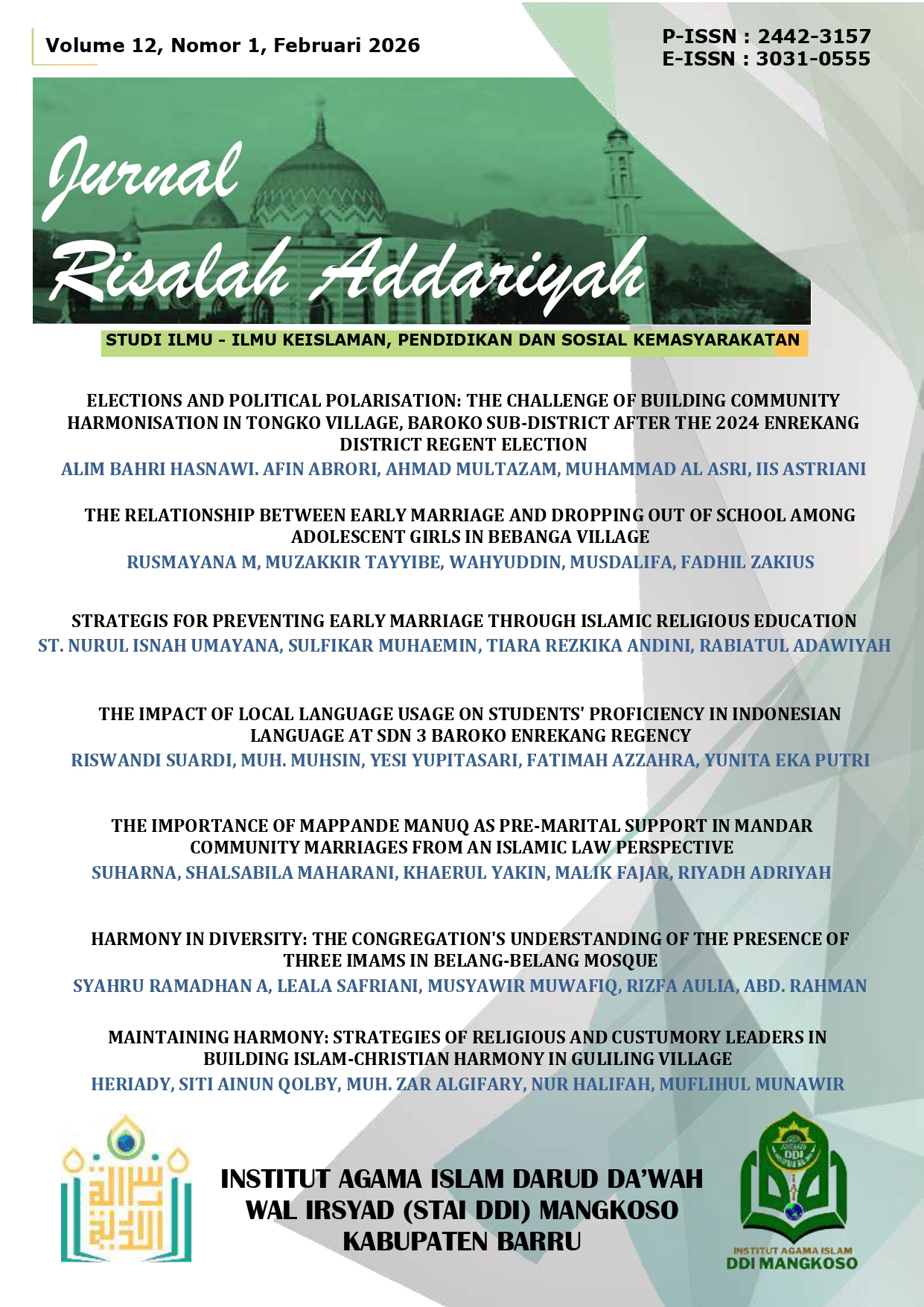
THE IMPACT OF LOCAL LANGUAGE USAGE ON STUDENTS' PROFICIENCY IN INDONESIAN LANGUAGE AT SDN 3 BAROKO ENREKANG REGENCY
DOI:
https://doi.org/10.56324/jariyah.v12i1.113Keywords:
Local language, , Indonesian language, cultural preservation, language skills, primary education.Abstract
This study aims to analyze the impact of using local languages on students' proficiency in the Indonesian language at SDN 3 Baroko, Baroko Subdistrict, Enrekang Regency. Using a qualitative case study approach, the research involves students from grades IV, V, and VI, along with teachers and parents. Data were collected through observation and in-depth interviews to explore patterns of local language use and its influence on Indonesian language skills, including reading, writing, speaking, and listening. The findings indicate that using local languages positively impacts students by facilitating understanding during early learning stages, boosting confidence, and strengthening local cultural identity. However, negative effects were also observed, such as difficulties in mastering formal Indonesian terms, which affect academic performance and examination results. Proposed solutions include increasing the intensity of Indonesian language use in schools, training teachers in bilingual teaching strategies, utilizing Indonesian-based learning media, and implementing literacy programs. Collaboration between teachers and parents is also crucial to reinforce Indonesian language skills at home. With a balanced strategy, local language preservation can be achieved without hindering the mastery of Indonesian as the official language of national education.
References
Bahasa, Fungsi. n.d. Bahasa, Fungsi Bahasa, dan Konteks Sosial.
Darminto Wjs Poerwo, Kamus Besar Indonesia, Cet. 1; Jakarta: Balai Pustaka, 1993.
Bahasa, Fungsi. n.d. “Bahasa, Fungsi Bahasa, dan Konteks Sosial,” 1–19.
Firdausi, Novandina Izzatillah.. “No ????????????????????? ?????????????????Title.” Kaos GL Dergisi 8 (75): 2020.
Susiati, Joleha Nacikit. 2020. “Pentingnya Melestarikan Bahasa Daerah.” Open Science Framework, no. May, 1–5. https://doi.org/10.31228/osf.io/wk8xm.
Ummah, Masfi Sya’fiatul. No ????????????????????? ?????????????????Title. Sustainability (Switzerland). Vol. 11. 2019.
Downloads
Published
How to Cite
Issue
Section
License
Copyright (c) 2026 Riswandi Suardi, Muh. Muhsin, Yesi Yupitasari, Fatimah Azzahra, Yunita Eka Putri

This work is licensed under a Creative Commons Attribution-NonCommercial-ShareAlike 4.0 International License.
Copyright and Licensing
-
Copyright and Licensing
-
Usage Rights
All articles in this journal are licensed under the Creative Commons Attribution-NonCommercial-ShareAlike 4.0 International License (CC BY-NC-SA 4.0).
This license allows anyone to copy, distribute, display, and adapt the material in any medium or format, as long as the terms of the license are followed. -
License Terms
-
Attribution: Proper credit must be given to the original author, a link to the license must be provided, and any changes made must be indicated.
-
NonCommercial: The material may not be used for commercial purposes.
-
ShareAlike: If the material is remixed, transformed, or built upon, the resulting work must be distributed under the same license — CC BY-NC-SA 4.0.
-
No Additional Restrictions: You may not apply legal terms or technological measures that legally restrict others from doing anything the license permits.
-
-
Notices
-
The license does not apply to material in the public domain or uses permitted by legal exceptions or limitations.
-
No warranties are given by the licensor. Users are responsible for ensuring compliance with other rights, such as copyright, privacy, or moral rights.
-
-